
How to self-tape in Paris: a practical guide
Paris hosts most French castings and a steady flow of international ones. It also comes with specific home-recording conditions: small rooms, old floors, courtyards that carry every sound. This guide lists the constraints and the fixes, for actors based in Paris and for those passing through.
1. Distance: the scarcest resource
A mid-shot on a phone with the standard lens needs roughly 1.5 to 2 metres between lens and actor, plus about one metre between actor and backdrop to avoid a cast shadow: 2.5 to 3 metres of clear space in one line. In a 20 m² Paris studio flat, that line is usually the diagonal, and the diagonal usually runs through the bed.
- Look for the longest line in the room, not the emptiest wall.
- Do not switch to the ultra-wide lens (0.5x) to fit in: it distorts the face and casting directors spot it at once.
- Test the frame before you block the scene, not after.
2. Backdrop: plain, neutral, no biography
Mouldings, bookshelves, an open kitchen or a film poster pull the eye away from the performance. A plain wall, light or mid-grey, about 1.5 metres wide is enough for a mid-shot. A bedsheet shows every crease; paper or a rigid board holds better.
3. Sound: you can hear the neighbours, and they can hear you
Floors and walls in older Paris buildings carry voices, footsteps and music. Courtyards echo; the street brings scooters, sirens, early deliveries and weekday building works. It works both ways: a break-up scene played full voice at 10 pm will be heard on the staircase.
- Windows shut, curtains drawn, a rug on the floor: every soft surface cuts the echo.
- Bring the mic close to your mouth (lavalier, or a mic just above the frame) instead of relying on a phone two metres away.
- Shoot loud scenes during the day, and warn the neighbours if the scene calls for it: cheaper than a ruined take.
- Listen back to one take on headphones before shooting the rest: background noise is inaudible while you act.
4. Light: a courtyard window will not last a session
Daylight shifts within minutes and goes early in winter: in December the sun sets in Paris before 5 pm. A warm ceiling light from above hollows the eyes. Mixing daylight and bulbs gives two skin tones in one shot.
- One soft key light in front of you, slightly off to the reader's side.
- One colour temperature only: either the window or the lamps.
- Check that the first and last takes match.
5. The reader
Off camera, next to the lens, at your eye line, a little quieter than you. Requests often come with 24 to 72 hours' notice, so finding a reader is part of the preparation. A pre-recorded reader locks the rhythm of the scene and it shows: last resort only.
6. Deadlines, time zones and delivery
For international castings the deadline is usually given in the production's time zone. London is one hour behind Paris; Los Angeles is nine hours behind for most of the year. A Friday 10 am deadline in Los Angeles is Friday 7 pm in Paris. Allow for upload time too: a large file on a building or holiday-rental Wi-Fi can take an hour. Use the delivery method and file name requested.
7. Self-taping in French
If you are taping in French as a second language, read the brief on accent: some roles call for a native-sounding French, others for your own accent. A steady, natural accent serves you better than an approximate one that slips mid-scene. A session with a French-speaking coach before recording pays off in the take.
8. Home or studio: a decision grid
Home works when the scene is short, played at conversational volume, with a reader available and a flat that offers distance and a plain wall. A studio is the rational choice when:
- the deadline is under 24 hours and nothing is set up;
- the scene is loud or physical;
- two actors need to be in frame;
- you need a native reader or coach in French or English;
- you are visiting Paris without equipment or a suitable room.
Shooting at ForTape
- Address
- 3 rue Charles Baudelaire, building T, 75012 Paris. Ledru-Rollin (line 8), Bastille (lines 1, 5, 8) and Gare de Lyon (lines 1, 14, RER A and D) are a few minutes' walk away.
- Hours
- Slots from 9 am to 8 pm, bookable online. Arrive 10 minutes before your slot. The door code is sent by email.
- Rooms
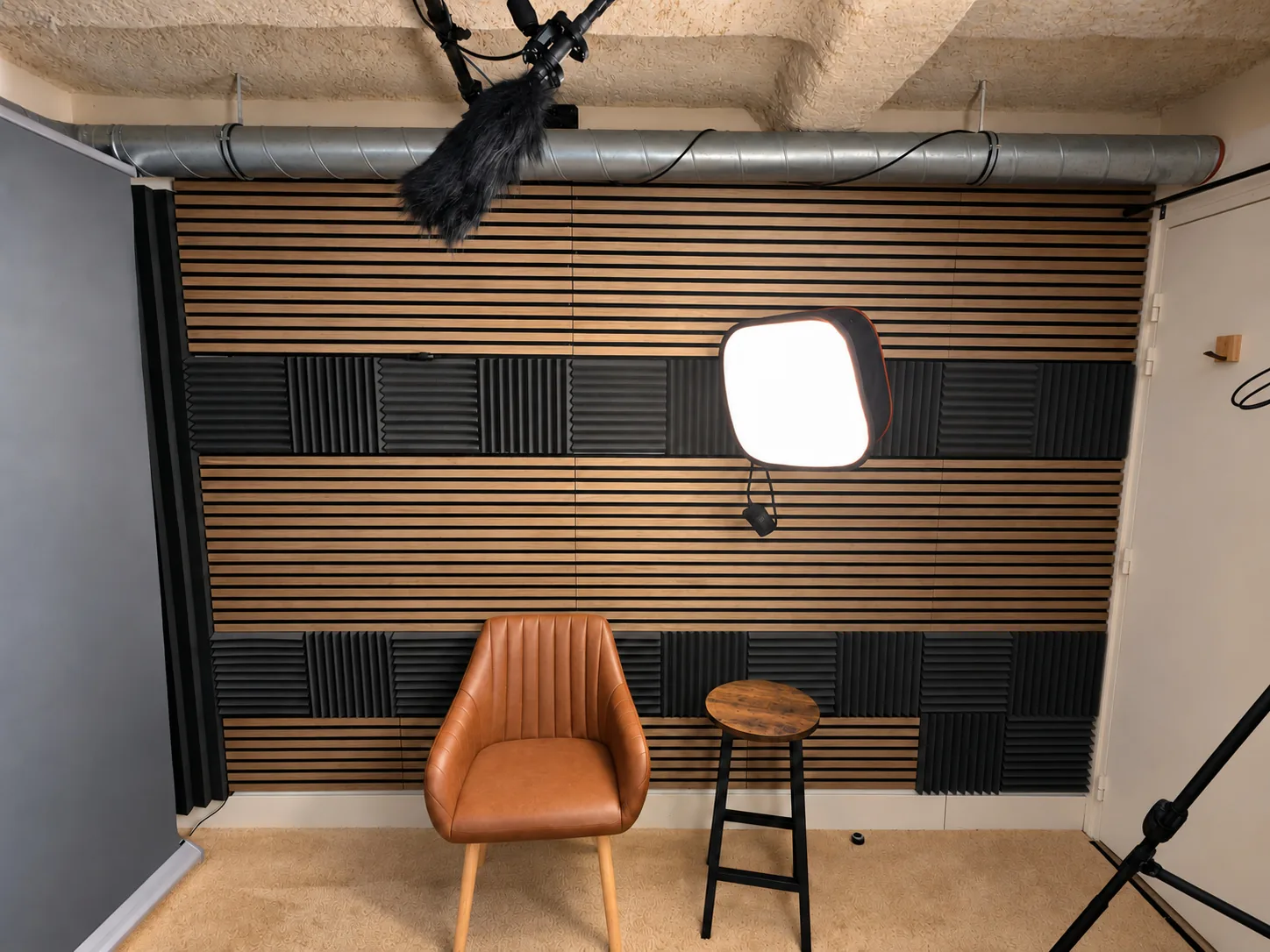
- Yellow Room for one actor on camera with an off-camera reader, from €24 per hour incl. VAT. Red Room (16 m²) for two-handers in frame and scenes with movement, from €36 per hour incl. VAT.
- Set up
- 4K camera, lights and mic in place, plain backdrop, one-button recording. Takes are dropped into your Dropbox folder during the session.
- Options
- Reader (€50/h) and coach, in French or English; Zoom pack for live online castings.
FAQ
How much space do I need for a self-tape?
About 2.5 to 3 metres in one line: 1.5 to 2 metres between lens and actor for a mid-shot, plus one metre between actor and backdrop.
Can I self-tape in a holiday rental in Paris?
Yes, if the room offers distance, a plain wall and quiet surroundings. Test the sound and the upload speed beforehand: Wi-Fi and acoustics are the usual weak points.
Is there a self-tape studio in Paris with an English-speaking reader?
Yes. ForTape (Paris 12) offers a reader and a coach in English or French as options, with camera, lights and mic already set up.
How much does a self-tape studio cost in Paris?
At ForTape (Paris 12), the Yellow Room is €24 per hour incl. VAT, with 4K camera, lights and mic set up and takes delivered on Dropbox during the session.